1.The seven payment methods in the rulebook
Article 6 of the Rulebook on types of fiscal receipts, transaction types, payment methods, references to other documents and details of other receipt elements says the receipt states one of the following, depending on how the buyer pays:
| Payment method | When it is used | In the API |
|---|---|---|
| Cash (gotovina) | banknotes and coins | Cash |
| Instant payment | an instant credit transfer at the point of sale, for example by IPS QR code | MobileMoney |
| Payment card | payment by card, including on a website | Card |
| Cheque | payment by cheque | Check |
| Transfer to account | a payment order or transfer order — payment slip, e-banking | WireTransfer |
| Voucher | a voucher, money coupon, internal card or similar instrument | Voucher |
| Other non-cash payment | non-cash payment by any other means allowed by law in Serbia | Other |
The receipt prints the method in Cyrillic, with the amount, for example “Платна картица: 3.180,00”. The buyer sees that line on paper and on an electronic receipt, and the Tax Administration has it in every receipt it receives.
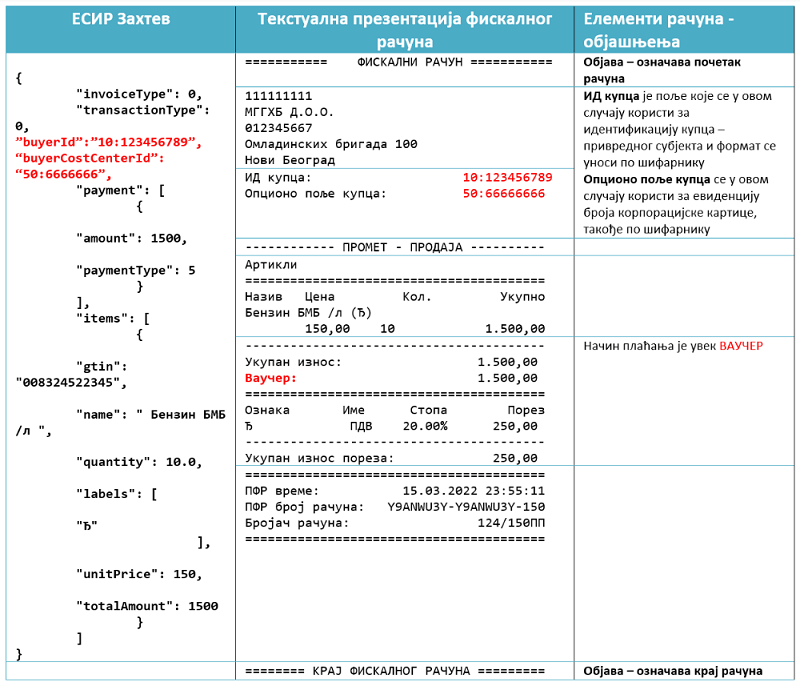
It is important to understand what this field does not change: the duty to issue a receipt. The Law on Fiscalization says a sale is recorded regardless of the payment method. Card, bank transfer or voucher do not exempt you from the receipt — they only change one line on it.
2.What is what in online sales
The rulebook is written to apply to both a shop till and online sales, so it does not name payment services. Pick how your buyer paid and see what goes on the receipt:
Pick one — the answer appears here.
Cash on delivery has one more rule, independent of the payment method: the receipt is issued when the courier collects payment, not when the order comes in. More on that on the online cash register page.
3.When the buyer pays two ways
Sometimes a buyer pays part with a gift card and the rest by card or cash. Paragraph 3 of the same article covers this explicitly: one receipt may list several payment methods, but the amount for each must be shown separately.
Move the slider and see how the amount is split on the receipt:
The buyer pays RSD 5,000: part by gift card, the rest by card
The parts add up to the receipt amount
The same through the API
"payments": [
  { "type": "Voucher", "amount": 2000 },
  { "type": "Card", "amount": 3000 }
]
The parts must add up to the receipt amount. FiskalAPI checks this before sending: if the sum and the amount do not match, the receipt is rejected with a message stating both, instead of reaching the Tax Administration with an error.
4.The special rule for restaurants and bakeries
Paragraph 2 of Article 6 makes an exception for serving food and drinks and for selling food and drinks in a bakery. The device that records those sales must have only these options:
- cash — which there covers banknotes and coins, instant payment at the point of sale, payment card and cheque;
- transfer to account;
- voucher;
- other non-cash payment.
In other words: when a restaurant or bakery charges your card, the receipt says “Cash” (Готовина). That is not a till error but a rule from the rulebook.
This exception applies only to those activities. If you run a restaurant or bakery and also sell online, check with your accountant which options apply to which sales.
5.The payment method on a refund
When you return money, you issue a refund referencing the number and time of the original receipt. In practice the refund carries the same payment method as the original, because the money goes back the way it came: to the card, to the account or in cash.
If you return money a different way than it was paid — for example the buyer paid cash on delivery and you refund to their bank account — confirm with your accountant how to show it.
6.The most common mistakes
- The same method for every order. A shop set to “Payment card” reports a card for buyers who paid cash on delivery or by bank transfer. The method should be read from the order.
- No payment method sent at all. FiskalAPI then records “Payment card” — correct only if the buyer really paid by card.
- Cash for a bank transfer. Paying with a payment slip or e-banking is a “Transfer to account”, not cash, even if the buyer paid the slip in cash at the post office.
- In a split payment, the parts do not add up to the receipt amount.
- Cash on delivery issued at packing time, before payment — the receipt then exists for a payment that has not happened yet.
All FiskalAPI online shop modules read the payment method from the order itself, and for cash on delivery you choose in the settings how it is reported.
7.Payment methods through FiskalAPI
A single payment method is sent in the paymentType field. A split payment is sent as a payments array, with an amount for each part:
"payments": [
  { "type": "Voucher", "amount": 2000 },
  { "type": "Card",    "amount": 3000 }
]
Allowed values are Cash, MobileMoney, Card, Check, WireTransfer, Voucher and Other — one for each method in the rulebook. FiskalAPI rejects an unknown value before sending.
Frequently asked questions
Seven, under Article 6 of the rulebook: cash, instant payment, payment card, cheque, transfer to account, voucher and other non-cash payment. Restaurants and bakeries have a narrower list.
Yes. The rulebook allows several payment methods on one receipt, provided the amount paid by each is shown. The parts must add up to the receipt amount.
The rules do not name PayPal. In practice it is reported as a payment card or as other non-cash payment; your accountant confirms which one applies to you.
Because of the special rule for serving food and drinks and for bakeries: for them the “cash” option covers banknotes, instant payment, payment card and cheque. For other activities a card is shown as “Payment card”.
Non-cash payment by any means allowed by law in Serbia that is none of the other six — not a card, transfer to account, instant payment, cheque or voucher.
As “Transfer to account” — a payment made by payment order or transfer order. Not as cash, even when the buyer paid the slip in cash at the post office.
Sources: Rulebook on types of fiscal receipts, transaction types, payment methods, references to other documents and details of other fiscal receipt elements (Art. 6; Official Gazette of RS nos. 31/2021, 99/2021, 10/2022, 49/2022, 50/2022 and 57/2022), the Law on Fiscalization (Art. 4) and the Tax Administration help page “Fiscal receipt” (tap.suf.purs.gov.rs). Confirm your case with your accountant.