1.Are services and digital products fiscalized
Yes, when you sell them to individuals. The Law on Fiscalization treats anyone making retail sales as a fiscalization taxpayer, and retail is not only selling goods — it also covers providing services to individuals. An app subscription, an online course, a membership, an e-book and a software licence are retail sales just like a T-shirt in a shop.
The payment method does not change that either: the law says a sale is recorded regardless of how it was paid. A subscription charged automatically to a card every month gets a fiscal receipt for every charge.
For a business selling exclusively online, its registered seat counts as the retail outlet. It needs no shop and no fiscal cash register: approved software issuing receipts through the Tax Administration’s virtual processor (V-PFR) is enough.
The Government can designate activities exempt from fiscalization. Check with your accountant whether yours is one of them before concluding you need no receipts.
If you also sell to companies and entrepreneurs, confirm with your accountant whether they need a fiscal receipt or an invoice. When a fiscal receipt is issued to a company, it carries the buyer’s tax ID (PIB).
2.When the receipt is issued: before or after the service
A fiscal receipt is issued at the moment of the retail sale. For services and subscriptions that makes one question key: did the buyer pay before the service was provided, or at the moment they received what they paid for?
- Paid before the service — an annual subscription paid upfront, a course starting later, a bundle of sessions: the payment is an advance. An advance receipt is issued, and the advance is closed once the service is provided.
- Paid at the moment of receiving the product — downloading an e-book, a licence that works immediately, access right after payment: one sale receipt is issued.
- Pays after use — usage billing at the end of the month: a sale receipt for the amount charged.
How an advance is closed and what each receipt references is explained step by step in the advance receipt guide. Here we show what it looks like for the most common billing models.
3.Which receipt for which billing model
Pick how you bill and see which receipts you issue:
Pick one — the list of receipts appears here.
For a monthly subscription charged at the start of the month the decision is not always obvious: under the advance rule that is three receipts a month per customer, while some businesses decide with their accountant that the service is provided the moment the buyer gets access — then one sale receipt is enough. Your accountant makes that call, not the software. FiskalAPI supports both flows.
4.Automatic renewal: every charge is a new receipt
A fiscal receipt confirms that a specific payment was received or refunded. So every charge is a separate receipt: when the card is charged for the next month, a new receipt is issued — the previous one is not changed or repeated. If the charge fails, there is no receipt, because there is no payment.
With automatic renewal the flow looks like this:
- 1The charge succeedsThe payment processor tells your system the card was charged for the new period.
- 2Your system requests a receiptIt calls FiskalAPI with the amount, the item and the ID of that charge as transactionId.
- 3The receipt is issuedThe response brings the receipt number, the verification link and the QR code.
- 4The buyer gets the receiptPut the verification link into your renewal email — you send the email to your customer, from your own domain.
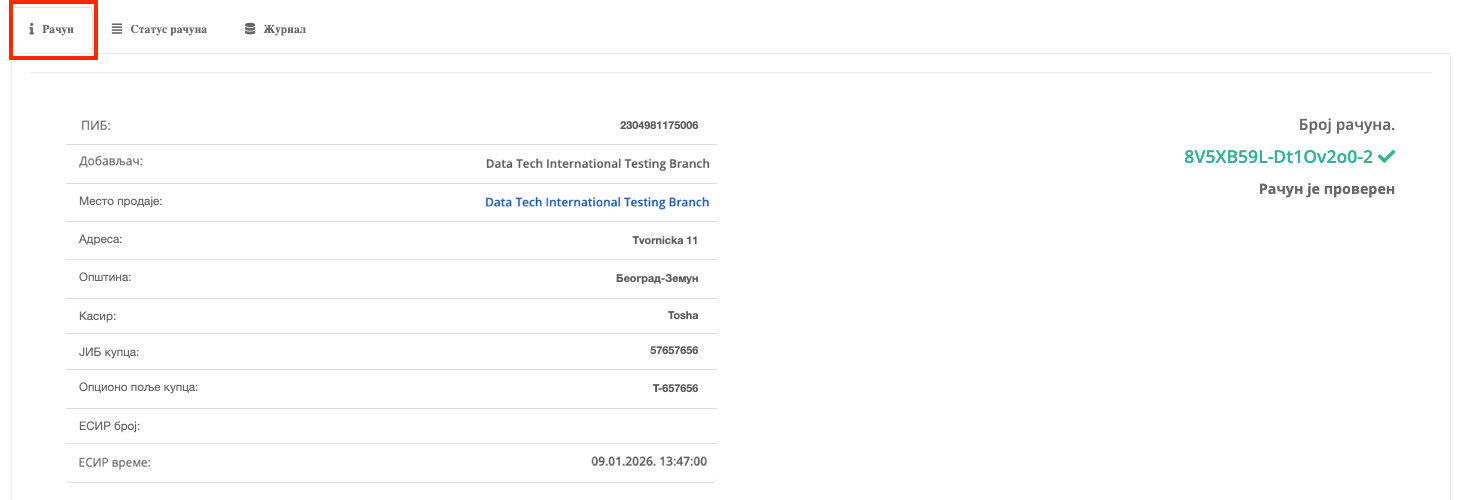
Processors often send the same notification two or three times when a response is slow. A duplicate fiscal receipt can only be corrected with a refund, so protection is built in: a repeated call with the same transactionId returns the same receipt instead of issuing a new one.
If you do not issue receipts at the moment of the charge but later — for example in a nightly job — send the actual charge time in the occurredAt field. It is recorded as the ESIR time, so the receipt matches the card transaction statement.
5.Cancellation, refund and plan changes
An issued receipt is never changed. Everything that happens after a charge — cancellation, refund, plan change — is handled by a new document that references the first:
- Full refund: a refund of the whole amount, referencing the PFR number and PFR time of the original receipt.
- Partial refund, for example for unused days: a refund only for the amount you return. If you later return another part of the same charge, that is a new refund with a different transactionId.
- Cancellation without a refund: nothing is issued. The receipt for the period already paid stays as it is, and there simply is no next charge.
- Upgrade mid-period: the extra payment is a new charge and gets its own receipt.
- Cancelling a prepaid advance before the service starts: an advance refund on the last advance, with no final receipt.
If on a downgrade you do not return the difference but offset it against the next charge, confirm with your accountant how to show that on the receipts.
6.What the receipt for a service says
The item is the name of the service as the buyer recognises it — for example “Pro subscription, March 2026” or “Online course: Excel for beginners” — with quantity and price. A unit of measure can follow the name. The tax label works as for goods: А if you are outside VAT, Ђ or Е by rate if you are in it.
ПРОМЕТ ПРОДАЈА
Pretplata Pro, mart 2026 (А)   1 × 2.400,00
Укупан износ                    2.400,00
Платна картица:                 2.400,00
A business selling exclusively online issues the fiscal receipt in electronic form (Article 13, paragraph 3 of the rulebook) — an email with the verification link is enough, with no paper and no separate consent from the buyer. A business that also has a physical shop issues a printed receipt and may deliver it electronically only with the buyer’s consent.
7.Foreign customers and foreign currency
Amounts on a fiscal receipt are in dinars. If you charge the subscription in euros or dollars, the converted dinar amount goes on the receipt. Agree with your accountant on the exchange rate and the conversion day, and apply them consistently.
Whether a sale to a foreign customer is subject to fiscalization and Serbian VAT at all depends on the type of service and on who the buyer is. It is a tax question settled once, for the whole billing model — with your accountant, before the first charge.
8.Subscriptions through FiskalAPI
Every billing model comes down to a few API calls, and the whole flow also works on the free test key, with no tax consequences:
| Situation | Call |
|---|---|
| Charge at delivery or after | POST /api/racuni |
| Charge upfront (advance) | POST /api/racuni/avans |
| Closing the advance once the service is provided | POST /api/racuni/avans/refundacija, then POST /api/racuni |
| Refund | POST /api/racuni/refundacija |
POST /api/racuni
{
  "transactionId": "ch_3PqX81",
  "paymentType": "Card",
  "items": [
    { "name": "Pretplata Pro, mart 2026", "quantity": 1,
      "unitPrice": 2400, "labels": ["А"] }
  ]
}
Frequently asked questions
Yes, when individuals pay for them. Under the Law on Fiscalization retail includes providing services to individuals, and a sale is recorded regardless of the payment method — including automatic card charges.
Yes. A fiscal receipt confirms that a specific payment was received, so every successful charge gets a new receipt. A failed charge gets none, because there is no payment.
Yes, when individuals buy them. When the product is delivered right after payment — a download, a licence, access — one sale receipt is issued at the moment of payment.
With a refund referencing the number and time of the original receipt, for the amount you return. If the cancellation comes without a refund, nothing is issued — the receipt for the paid period stays.
With FiskalAPI no second receipt is issued: a repeated call with the same transactionId returns the receipt already issued. That is why you send the processor’s charge ID as the transactionId.
The fiscal receipt is in dinars, so an amount charged in euros is converted. Agree on the exchange rate and conversion day with your accountant and apply them consistently.
Sources: Law on Fiscalization (Art. 3, 4 and 6; Official Gazette of RS nos. 153/2020, 96/2021, 138/2022 and 80/2026), the Rulebook on types of fiscal receipts… (Art. 13), Tax Administration instructions on advance payments and the help page “Fiscal receipt” (tap.suf.purs.gov.rs). Confirm with your accountant whether your billing is an advance or a sale.